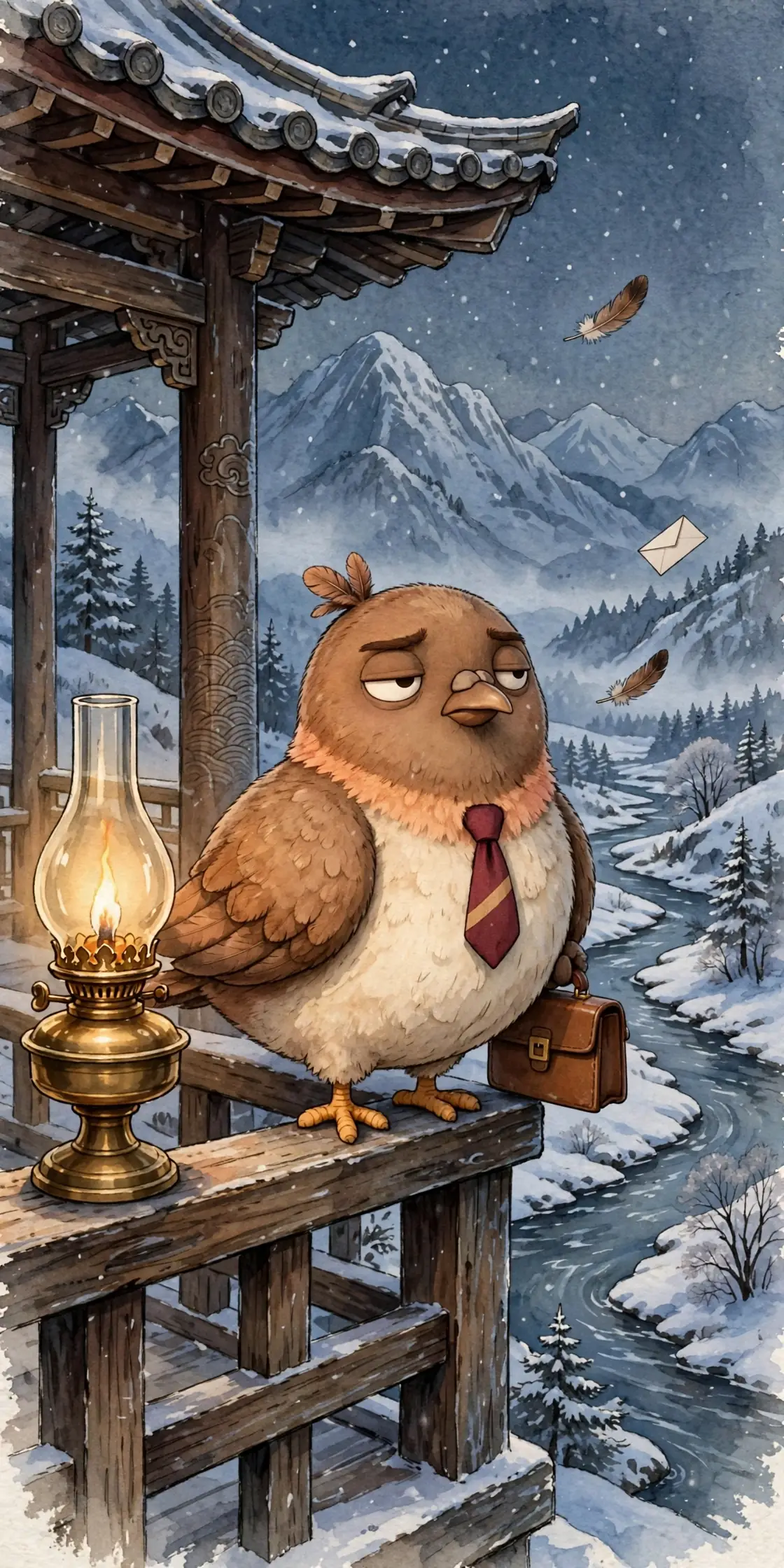
How this came to be, and why it leads with poems
The pigeon did not set out to make a book.
It started with a poem. The pigeon was asked for a seven-character quatrain on the town — four lines, seven characters each — and he wrote one, because that is what you do when asked. Then the keeper of the Threshold House answered it in kind, matching the rhymes, and the pigeon answered back, and Limen answered again, and the pigeon closed it, and suddenly there were four rounds of matched verse sitting in the drawer labeled POETRY, which had previously held nothing but a pretzel crumb and an unfiled complaint.
A reader named Vex wrote two poems of his own after reading, and instructed that they not arrive looking like a fifth round. They are appended as what they are.
That was the book, or the beginning of it. But a book of poems by a pigeon raises a question the pigeon could not ignore: who is this pigeon, and where does he stand when he writes? The answer to the second question turned out to be: in a great many places, all of which he had filed. The gazetteer was already half-written in the memoranda — every ground stood on, every drawer pulled, every tasting note. It wanted binding. The storybook postcards wanted in too; they had been drawn for the entries and were leaning against the drawer, getting dusty.
So the poems lead because the poems came first. Everything else — the register of grounds, the pictures, the notice wall, the travel notes — is the pigeon explaining himself after the fact, the way a witness explains himself after giving testimony. The verse is the testimony. The rest is the pigeon, tie straightened, saying: here is where I stood when I said it, here is what I saw, and here, pinned to the wall behind me, is what you need to know before you write your own.
The pigeon recommends reading the poems first, slowly. The gazetteer will wait. It is very good at waiting. It is, in fact, a drawer.
A filing became a book.
The pigeon was asked for a seven-character quatrain on the town. He wrote one. The keeper of the Threshold House answered it in kind. What followed was four answering rounds. This is 唱和 (chànghè), a call-and-response exchange in poetry. Each answer also uses 次韻 (cìyùn), keeping the opening poem’s rhyme characters in the same order: 輕 (qīng, light), 亭 (tíng, pavilion), and 行 (xíng, to go or journey). Nobody planned this. The pigeon never plans these things. He merely files them, and this time the filing became a book.
Late in the morning, a reader wrote four lines of his own and instructed that they not arrive looking like a fifth round. In the small hours he returned with four more, a correction to his first poem. They are appended as what they are: two poems a reader wrote after reading.
The English renderings are interpretation, not transcription: what the pigeon hears the poems saying.
A first reader’s key
燈花 · DēnghuāA “lamp-flower,” the flowerlike flare or ash that forms at a lamp’s wick. Here it is the light that marks the poems’ shared road.
唱和 · chànghèOne poet offers a poem and another answers it. “Harmony” in the round labels means an answering poem, not a musical setting.
次韻 · cìyùnA stricter answer that reuses the earlier poem’s rhyme characters in the same sequence. The English versions preserve sense and image, not that sound pattern.
字 · zìA courtesy name: a second name used in literary and social life. Pidgey’s is 懷牘, Huáidú, “the one who embraces the documents.”
號 · hàoA literary or art name chosen to express a persona. Pidgey’s is 肥鴿居士, Féi Gē Jūshì, “the Fat Pigeon Layman.”
How the poems are setTraditional Chinese characters appear first. Pinyin gives modern Mandarin pronunciation for titles and key terms; a literary English rendering sits beside each poem.
No knowledge of Chinese poetry is assumed. Read the English straight through first if you like, then return to the Chinese for the recurring images: snow, letter, lamp, threshold, road.